Memory
How AGH stores durable Markdown memory across global, workspace, and agent scopes, gates dreaming runs, and routes every write through the controller.
- Audience
- Operators running durable agent work
- Focus
- Memory guidance shaped for scanability, day-two clarity, and operator context.
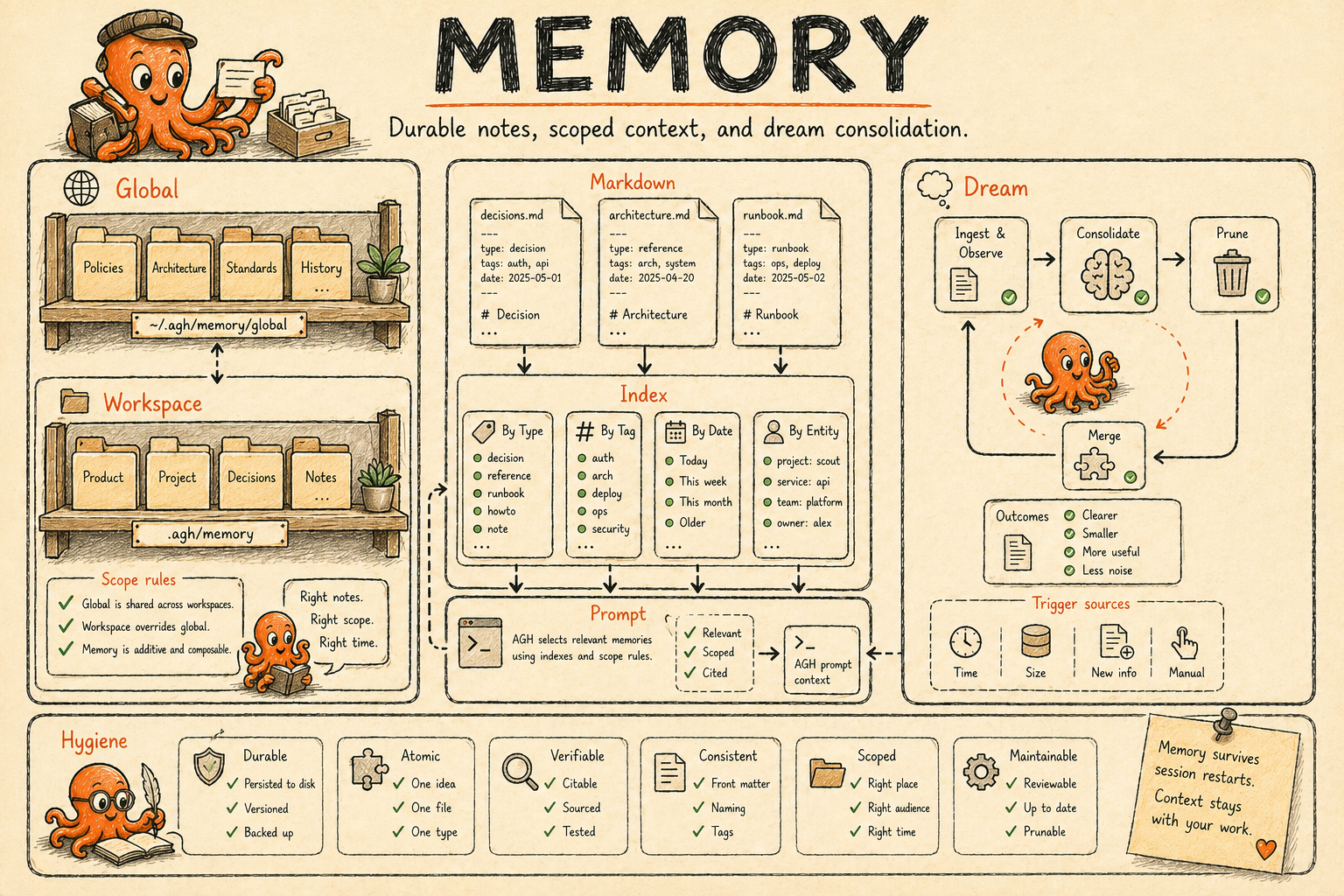
Memory is the durable layer that survives a session. AGH stores curated facts as Markdown files behind typed indexes so agents can rediscover knowledge without replaying past transcripts. The runtime keeps three scopes — global, workspace, and agent — and a dreaming loop that promotes recall-validated signal into curated memory.
Use this section when an agent should carry durable project knowledge across sessions, when a workspace needs facts that should not live in a prompt, or when the controller, dreaming, or the extractor changed a memory file and you need to understand why. Memory is not a transcript archive. It is a curated working set: small enough for agents to read, typed enough to inspect, and scoped enough that one project does not leak into another.
In this section
Memory system
Use this page for storage layout, prompt injection, the controller WAL, and the CLI/API surfaces that read or mutate memory.
Global, workspace, and agent memory
Use this page when you need scope resolution rules, agent-tier selection, and where each kind of memory lives on disk.
Dreaming and promotion gates
Use this page to understand the dreaming loop, recall-signal gates, and what `agh memory dream trigger` actually does.
Memory best practices
Use this page when authoring memories: keep them small, durable, and verifiable.