Hooks
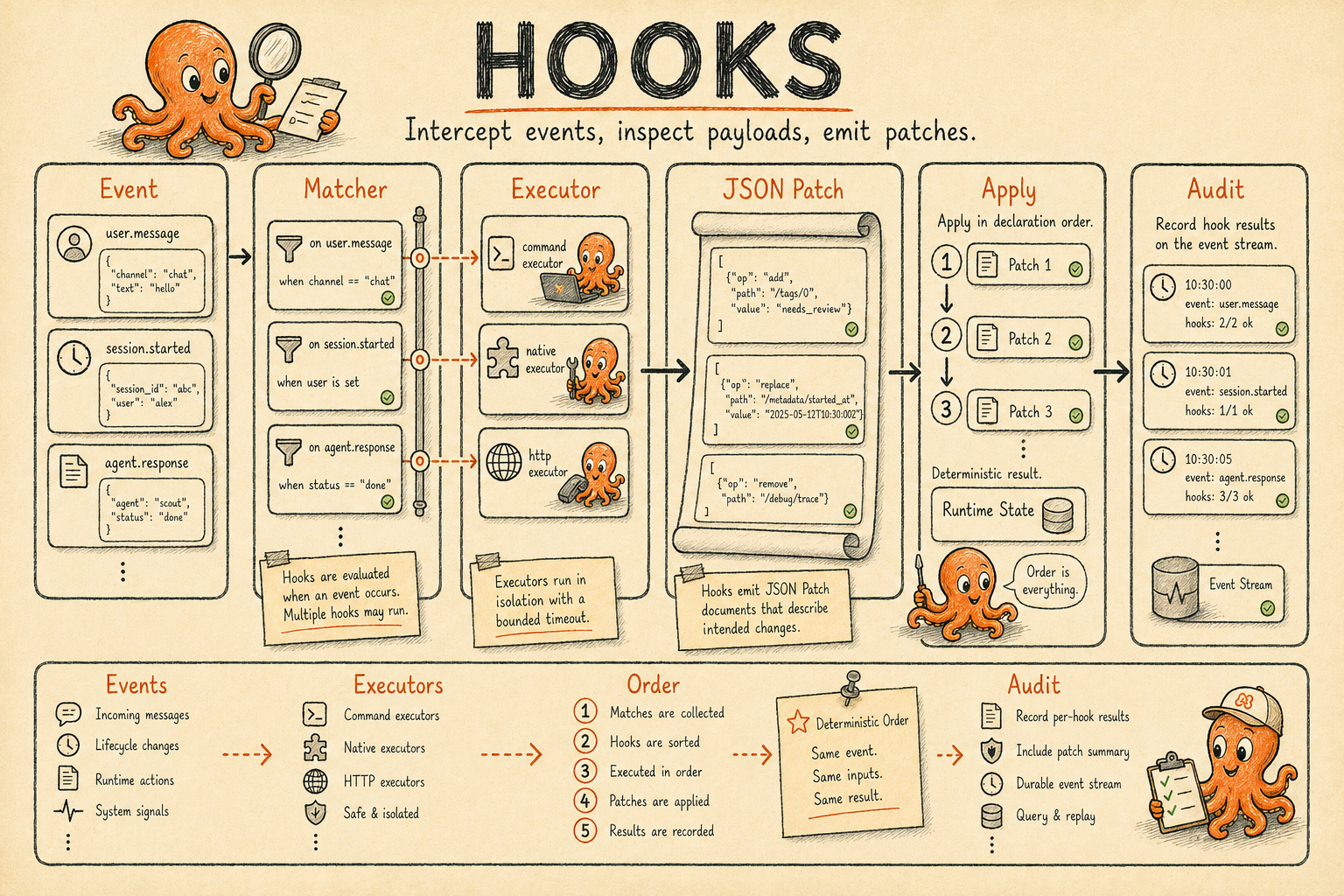
Intercept named runtime events, inspect the payload, and emit a JSON patch that AGH applies in a deterministic order.
- Audience
- Operators running durable agent work
- Focus
- Hooks guidance shaped for scanability, day-two clarity, and operator context.
Hooks are the policy and observability layer between runtime events and the actions that follow. A declaration binds a named event to an executor; the executor returns a JSON patch; AGH applies patches in declaration order and records the outcome on the session event stream.
In this section
Hook event catalog
Use this page for the complete event list, payload schemas, patch schemas, and which events support synchronous mutation.
Hook declaration format
Use this page when authoring hooks: matchers, subprocess executors, ordering, and execution behavior.
Memory v2 Hooks
Two hook events feed the Memory v2 pipeline:
session.message_persistedfires after a transcript message is durably stored. The Memory v2 extractor consumes this event asynchronously, runs bounded per-session work, stages candidates under_inbox/, and routes accepted proposals through the controller.session.post_stopqueues a workspace-scoped dreaming check; the gated dreaming runtime decides whether to start adreaming-curatorsession for that workspace.
Memory hooks never bypass the controller. Extractor outputs route through Store.ProposeWrite /
agh__memory_propose, and dreaming promotions are real memory_decisions rows with
origin = dreaming. See Memory System for the controller path and
Dream for the gate cascade.
Management surfaces
Hooks are agent-manageable for mutable sources. The agh__hooks toolset and the parallel
agh hooks CLI both call the same hook normalization, validation, and persistence pipeline.
| Surface | Read tools | Mutation tools | CLI parity |
|---|---|---|---|
| Catalog | agh__hooks_list, agh__hooks_info | — | agh hooks list, agh hooks info |
| History | agh__hooks_events, agh__hooks_runs | — | agh hooks events, agh hooks runs |
| Declaration | — | agh__hooks_create, agh__hooks_update, agh__hooks_delete | overlay edits in config.toml plus daemon reload |
| Lifecycle | — | agh__hooks_enable, agh__hooks_disable | overlay edits plus daemon reload |
Source-owned hooks (extension manifests, skill metadata, native daemon hooks) stay structurally
immutable through agent tools. Mutating tools require approval and reject secret-bearing
executor environments with deterministic codes such as HOOK_SOURCE_IMMUTABLE,
HOOK_SECRET_INPUT_FORBIDDEN, HOOK_VALIDATION_FAILED, and HOOK_APPROVAL_REQUIRED.