Bridges Overview
How AGH bridge instances connect workspace agents to external messaging platforms.
- Audience
- Operators running durable agent work
- Focus
- Bridges guidance shaped for scanability, day-two clarity, and operator context.
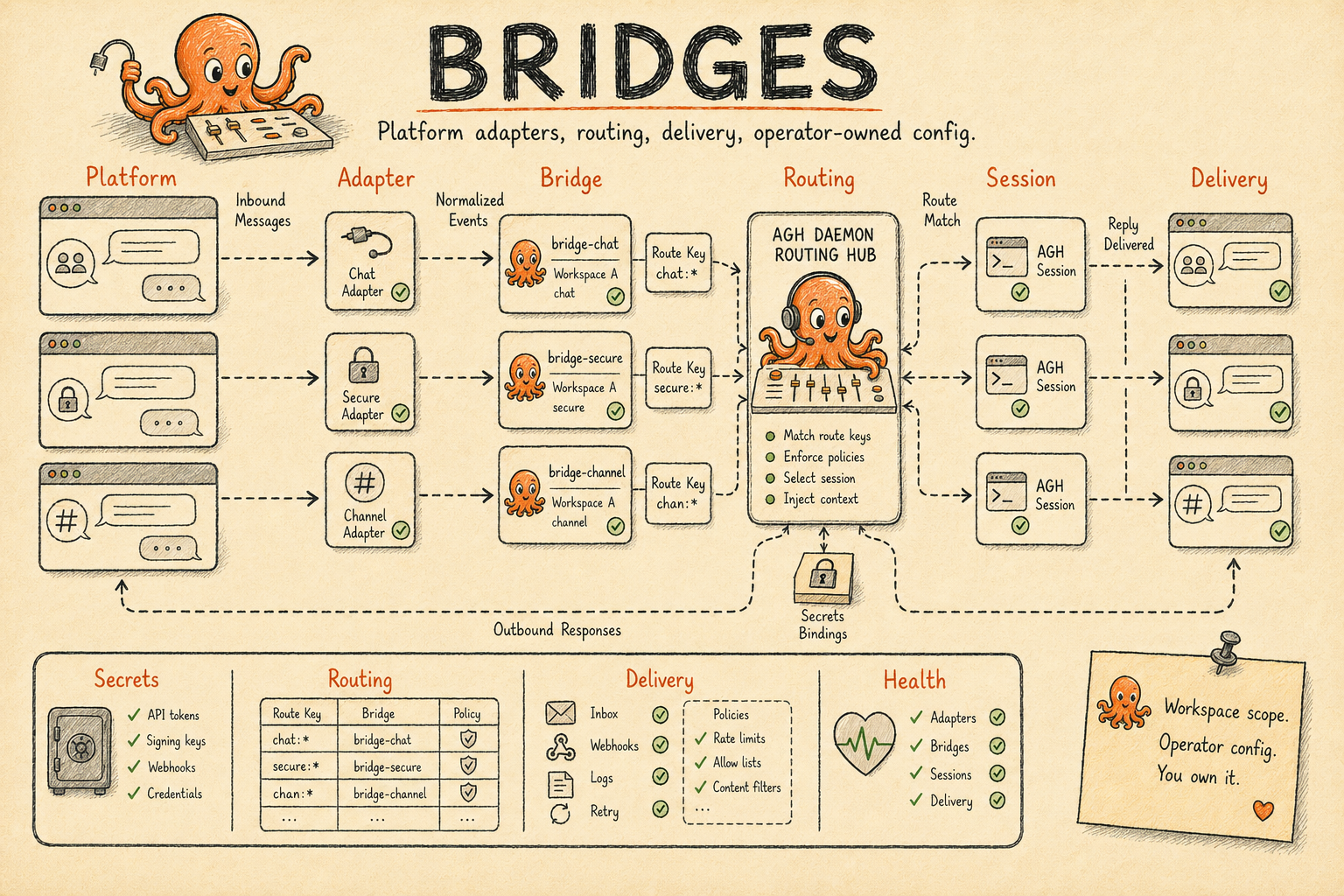
A bridge is a workspace-facing adapter between AGH sessions and a messaging platform. The platform
can be Slack, Discord, Telegram, or any installed extension that advertises the bridge.adapter
capability. The bridge instance stores the operator-owned configuration; the provider extension owns
platform-specific webhook validation, message normalization, and outbound delivery.
That split keeps AGH responsible for sessions, routing, persistence, and delivery bookkeeping while letting each platform adapter speak the platform API directly.
In this section
Message Routing
How platform identities become stable route keys and durable AGH sessions.
Platform Setup
Configure Slack, Discord, and Telegram bridges with webhook paths, secrets, and routing.
Runtime model
| Object | Owned by | What it does |
|---|---|---|
| Provider extension | Extension catalog | Declares bridge.adapter, platform name, display name, required secret slots, and provider config schema hints. |
| Bridge instance | AGH bridge registry | Stores scope, workspace, provider selection, routing policy, delivery defaults, provider config, status, and degradation metadata. |
| Secret binding | AGH daemon | Maps a provider slot such as bot_token to a vault-backed secret reference and stores the write-only secret value encrypted. |
| Bridge route | AGH routing layer | Maps one canonical platform identity to one AGH session and agent name. |
| Target directory | AGH daemon | Stores provider-discovered immutable target identities and resolver indexes for operator-friendly names. |
| Delivery target | Delivery broker | Identifies where a response should be posted, replied to, edited, or deleted on the platform. |
The provider catalog is dynamic. GET /api/bridges/providers returns every installed and enabled
extension that provides bridge.adapter. In this repository, the catalog includes provider
manifests for Slack, Discord, Telegram, WhatsApp, Microsoft Teams, Google Chat, GitHub, and Linear.
This setup guide covers Slack, Discord, and Telegram because those are the supported walkthroughs for
this section.
Message flow
Rendering diagram…
Adapter architecture
The bridge adapter runs as an extension subprocess. During initialization, AGH gives it the bridge instances assigned to that extension and a Host API surface. The adapter then:
- Resolves bridge secret bindings from the daemon-provided cache.
- Starts webhook listeners for configured bridge instances.
- Verifies incoming platform requests before ingestion.
- Converts platform payloads into normalized bridge envelopes.
- Reports bridge state back to AGH as
ready,degraded,auth_required, orerror. - Delivers response events back to the platform API and acknowledges delivery to AGH.
AGH does not parse Slack, Discord, or Telegram webhook payloads in the daemon. The daemon accepts the normalized envelope only after the provider extension authenticates itself and the bridge instance is enabled for that extension.
Bridge instance format
Bridge instances are persisted runtime records. They are created through the bridge API or the
agh bridge create command, not through config.toml.
{
  "scope": "workspace",
  "workspace_id": "ws_8f33a913d23c4fd1",
  "platform": "slack",
  "extension_name": "slack",
  "display_name": "Slack support",
  "enabled": false,
  "status": "disabled",
  "dm_policy": "allowlist",
  "routing_policy": {
    "include_peer": false,
    "include_thread": true,
    "include_group": true
  },
  "provider_config": {
    "webhook": {
      "listen_addr": "127.0.0.1:18081",
      "path": "/slack/support"
    },
    "dm": {
      "allow_user_ids": ["U0123456789"]
    }
  },
  "delivery_defaults": {
    "group_id": "C0123456789",
    "thread_id": "1713200000.000100",
    "mode": "direct-send"
  }
}| Field | Required | Notes |
|---|---|---|
scope | yes | workspace or global. Use workspace for inbound sessions. |
workspace_id | workspace only | Required when scope is workspace; forbidden for global. |
platform | yes | Platform identifier such as slack, discord, or telegram. |
extension_name | yes | Installed extension that owns the provider, usually the same as the platform. |
display_name | yes | Operator-facing name shown by CLI/API output. |
enabled | yes | Disabled instances do not accept routing work. Create disabled, bind secrets, then enable. |
status | yes | disabled, starting, ready, degraded, auth_required, or error. |
dm_policy | no | open, allowlist, or pairing; empty normalizes to open. Providers enforce this against their dm config. |
routing_policy | yes | Chooses which platform identity dimensions join the canonical route key. |
provider_config | no | Provider-owned JSON object. The transport accepts any JSON object or null; each adapter validates the keys it uses. |
delivery_defaults | no | JSON object with peer_id, thread_id, group_id, and mode. thread_id requires peer_id or group_id. |
Package-managed instances can be created by extension bundles. Those records report
source: "package" and reject direct spec mutation through the generic update API.
Supported provider slots
| Provider | Required secrets | Optional secrets | Webhook auth |
|---|---|---|---|
| Slack | bot_token, signing_secret | none | Slack request signing secret. |
| Discord | bot_token, public_key | none | Discord Ed25519 interaction signature headers. |
| Telegram | bot_token | webhook_secret | Telegram X-Telegram-Bot-Api-Secret-Token header when configured. |
Bind each slot to an AGH-managed vault secret before enabling the bridge. The API accepts the
plaintext only through the write-only secret_value field and never returns it:
curl -X PUT http://localhost:2123/api/bridges/brg_123/secret-bindings/bot_token \
  -H "Content-Type: application/json" \
  -d '{"secret_ref":"vault:bridges/brg_123/bot_token","secret_value":"xoxb-...","kind":"token"}'
The reference must be scoped to the edited bridge: vault:bridges/<bridge>/<slot>. Restart or
enable the bridge after changing a binding so the provider receives fresh launch material.
Bridge Vault refs are visible as redacted metadata through the Vault page, agh vault list --namespace bridges, and /api/vault/secrets?namespace=bridges. The plaintext secret_value is
accepted only on write.
Operational states
| Status | Meaning | Ingest behavior |
|---|---|---|
disabled | Operator disabled the instance. | Rejected as unavailable. |
starting | Extension is launching, restarting, or reconnecting. | Rejected until the provider reports readiness. |
ready | Provider is healthy and can ingest and deliver. | Accepted. |
degraded | Provider can still work but reported a known issue. | Accepted; health payload includes the degradation reason. |
auth_required | Required credential or platform authorization is missing or invalid. | Rejected until fixed and restarted. |
error | Provider reached a terminal or repeated fault. | Rejected until restarted or repaired. |
Bridge health is exposed with each bridge payload and through the bridge health stream. It includes route count, delivery backlog, dropped delivery count, delivery failures, auth failures, last success, last error, and degradation metadata.
Target directory
Bridge adapters can report platform targets such as channels, rooms, users, groups, and threads.
Adapters that do not implement native target enumeration use AGH's fallback snapshot from the bridge
instance's operator-declared delivery defaults. The daemon validates snapshots, writes
bridge_target_directory, and records the latest successful refresh time. The directory refreshes
when an extension runtime connects and then every five minutes while that runtime remains connected.
The bundled v1 Slack, Discord, and Telegram walkthroughs use those operator-declared delivery
defaults for target snapshots. Native platform discovery such as Slack conversations.list is not
part of the v1 target-directory contract.
Each target stores the provider-derived immutable route, display name, normalized lookup key,
optional qualifier, type, capabilities, updated_at, and last_seen_at. Missing targets are not
deleted during refresh; their last_seen_at remains the last time the provider saw them so operators
can distinguish stale but known targets from new unknown names.
Use the target APIs before wiring notification presets or explicit outbound targets:
agh bridge targets brg_123 --query launch -o json
agh bridge resolve brg_123 "launch room" -o json
The HTTP/UDS equivalents are GET /api/bridges/:id/targets and
POST /api/bridges/:id/resolve. Resolve returns a structured diagnostic for ambiguous or unknown
names instead of selecting a candidate silently.
Notification suppression
Each bridge instance has a live notification_suppress flag. When it is true, the common bridge
notification delivery path suppresses notification deliveries for that bridge and returns a
deterministic suppression result to the caller. Notification presets treat suppression as a terminal
skip and advance their cursor, so a muted bridge does not replay the same preset event forever. Task
bridge subscriptions and direct notifiers use the same common check.
Use suppression for planned bridge maintenance or noisy downstream systems. It is not a replacement for disabling the bridge: disabled or unhealthy bridges reject delivery as unavailable and leave cursors unadvanced for retry, while suppression intentionally records that the event was skipped for that bridge.